FEMA is putting $250 million into counter-drone capability for state and local agencies under its FY2027 Counter-UAS Grant Program. The money is real, the window is short, and most of the questions we are hearing from agencies come down to four things: who can apply, where the money actually lands, whether training counts, and what to do before the deadline.
Applications close November 16, 2026
Applications are due November 16, 2026, at 5 p.m. ET, submitted through FEMA GO. The period of performance runs December 10, 2026 through December 9, 2029, so this is a three-year capability build, not a one-off purchase.
Only state agencies apply. Local agencies subapply.
The eligible applicants are the 56 State Administrative Agencies (SAAs). Cities, counties, and local departments do not apply to FEMA directly: they are subapplicants through their state SAA. If your agency wants in, your first call is to your SAA, this week, not next.
97 percent of the money passes through
Per FEMA’s FAQ, SAAs must pass through at least 97 percent of the award to eligible subrecipients, with funds available within 45 days. This program was built to reach the local level. The gear lists, the staffing plans, and the training plans should be built at the local level too, because that is where the capability will live.
Training is an allowable expense, including vendor training
FEMA’s own fact sheet lists training among the allowable activities, including vendor-provided training and NCUTC certification pathways. Two certification notes that matter for planning:
- Operators of mitigation equipment must hold, or be enrolled in, the FBI NCUTC Mitigation Certification.
- Detection and warning work under the federal counter-UAS authority (6 USC 124n) requires the NCUTC Detection and Warning Certification, which is online and free. Detection equipment used outside that authority, such as radar, EO/IR, acoustic sensors, and Remote ID readers, is exempt from the certification requirement.
Readiness training, the kind that gets a unit’s people, procedures, and command integration ready before the gear arrives, sits squarely inside the allowable activities. Equipment without trained operators and a rehearsed first-ten-minutes playbook is a storage problem, not a capability.
What to do this week
- Call your SAA. Confirm their subapplication timeline; states set their own internal deadlines ahead of November 16.
- Inventory your exposure. Stadiums, fairs, critical infrastructure, correctional facilities: where would a drone incident hurt most?
- Line up your training plan now. Reviewers fund complete packages. A named training provider and a curriculum in the application beats a promise to figure it out later.
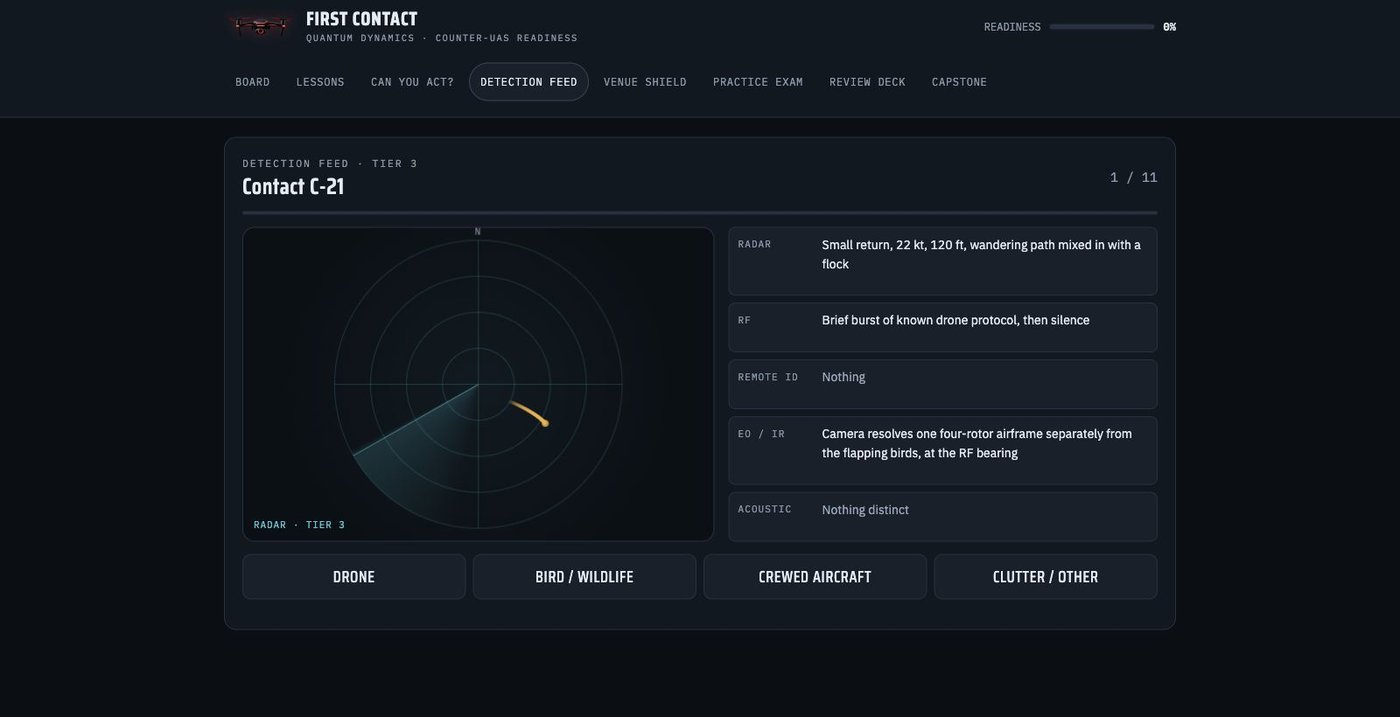
That last point is why we built First Contact: six modules of counter-UAS readiness training for the officers and supervisors who will own the first ten minutes of a drone incident. The founding cohort is forming now, ahead of the funding wave.